
These resources are available from www.mathsphere.co.uk:
Triangular Dotty Paper (similar to the page above, but with bolder dots)
These resources are available from www.mathsphere.co.uk:
Triangular Dotty Paper (similar to the page above, but with bolder dots)
These resources are from www.mathsphere.co.uk:
3D Drawing Paper 2 (slightly smaller scale)
These resources are from www.mathsphere.co.uk:
1 cm Graph Paper (excellent for use with standard 1 cm Cuisinaire rods)
Whether you are brand-new to the idea of homeschooling or you are a veteran homeschooler, there will be questions… What do I need to teach? What is Common Core and how does it relate to me? What are the laws in my state? Where can I find supplementary worksheets? Am I eligible for teacher discounts? Is my child developing normally?
This page is intended to help you find the answers to these questions.
Am I legal? What are the state laws?
Homeschooling is legal in every state in the U.S., but the requirements vary by state and even, in many states, by district. Here is detailed information, by state, provided by the Home School Legal Defense Association (HSLDA):
What do I need to teach?
The minimum requirements for a given year will vary by state law. Many states provide a list of “required subjects” that must be taught in a given year or every year. Some require more specific content or depth, while others do not. Check your laws carefully because they vary wildly.
Beyond the legal requirements, there is much latitude in what you may choose to teach your children and a wealth of resources available — the trick is in navigating the curriculum swamp and emerging with a workable plan!
“What Your Child Needs to Know When” – Robin Sampson is my go-to book for evaluating the scope and “level” of my kids’ academic knowledge so far. There is a ton of information in this book. Much, but not all, of it points to Mrs. Sampsons “Heart of Wisdom” curriculum, which I have not used. What I do refer to, time and time again, are her extensive checklists, organized by grade, of specific topics and tasks. This book can help put your mind at ease that your child is learning appropriately for his or her grade level, alert you to areas you may have missed or might want to review, and be enormously helpful in evaluating and designing your education plan.
What is Common Core, and should I care?
Here is the best resource I’ve found to answer Common Core questions:
Common Core is not a curriculum; rather, it is a set of standards and requirements that curriculum must meet. Currently, 43 states, the District of Columbia, and 4 territories have chosen to adopt Common Core and implemented standards for their jurisdiction. Homeschool families are not currently required to comply with their state’s Common Core. If you live in a Common Core state and choose at any point, for any reason, to enroll a child in public school, the curriculum used will be subject to Common Core requirements for your state. There is some concern that laws could change so that home schoolers could eventually be held to these same standards and their curriculum would also have to comply. At this point you do not need to be overly concerned about Common Core, but it is a good idea to be aware of your state’s standards.
Where can I find supplementary worksheets?
Education.com is a great resource for supplementary materials. You can download a good amount of information for free before they require you to join. I have found a membership to be worthwhile. It costs $36 per year or $99 for a lifetime membership, which will allow you unlimited downloads of teacher-created resources that are well-indexed and searchable by content and/or grade level. There are, of course, a lot of other places to find supplementary worksheets and materials, but this is the most comprehensive collection I’ve found.
Is my child developing “normally”?
This is, of course, subjective and controversial. But I include this link for two reasons: First, because it is an organized picture of what is common at various ages, and also because, as it is compiled using materials from the American Academy of Pediatrics and Bright Futures, it represents the information to which most physicians and governmental agencies refer in evaluating your child’s development.
“Growth Milestones” – KidsGrowth.com
Am I eligible for teacher discounts?
In many cases, you are. Most places will require you to show written proof that you are indeed a homeschooler. Generally this has meant a letter from your local school district stating that you are in compliance with their reporting requirements. The following link is for an organization that will, for $6, file your declaration of intent to homeschool with your local district and then will produce a printable, wallet-size “Home Educator Card” that identifies you as a registered Home Educator in compliance with your state’s reporting requirements.
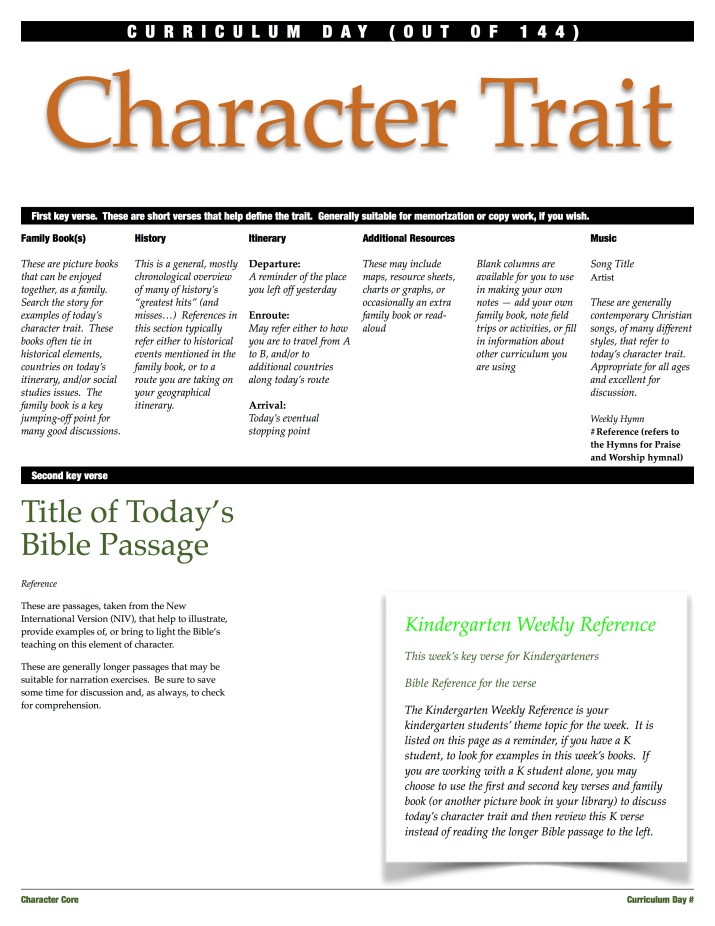
The “sticky note” feature in the lower right hand corner of the daily sheets is a kindergarten curriculum addendum. The year before I wrote the main Character curriculum, I developed a kindergarten curriculum based on themes found in the Creation story (Genesis 1 in the Bible). I designed the new curriculum to work in tandem with the original kindergarten curriculum.
For kindergarteners, here is what has worked for us:
The Family Book, character-related discussions, and the key verses for the day should include your kindergartener. Your kindergartener can and should also be included in art and music discussions, as well as conversations about geography and culture.
History study, beyond what is introduced in the Family Books, should not be necessary for children this young. The overview and topics included in the core should be more than sufficient. If you wish, you can supplement with books about children’s lives, transportation, housing etc. changing over time.
Choose math, reading and writing/handwriting curricula for your kindergartener, just as you would for your older children, and schedule this daily work for your little one. This will get him or her into the habit of doing their daily individual lessons, though of course you will find yourself working along with them for much of this rather than sending them off to complete it by themselves. Individually, I have my kindergarteners work with Inchimals, cuisinaire rods, pattern blocks, letter tiles, matching games and other manipulatives to practice and reinforce math, logic, and letter skills.
Science and Bible are two areas where the young student and older siblings may cover different content. The green heading at the top of the note is the kindergarten science theme for the week, and below it is a related verse (or portion of a verse) from John 1 or Genesis. If you have only a kindergarten student, you may wish to use the weekly verse or portion of a verse in this note instead of the longer Bible passage to its left. You may also choose to use this verse, or a portion of it, for copy work.
How you want to use the kindergarten theme is up to you. In most cases, one or more Family Books, and often the weekly hymn, will relate to this theme. You may wish to use additional books from your library to further investigate these topics. Additionally, these themes lend themselves well to science discussions and projects, art projects and drawings, and additional activities. Use your own judgement as to your child’s attention span, energy level, and interests.
The academic priorities for this grade level are to learn to count and write the numbers, say and write the alphabet, spell the child’s own name, learn the days of the week, and speak in full sentences. The child may progress into phonics and possibly learn to read.
Additional priorities are to develop physical skills, increase attention span, sit still for a period of time, follow along with picture books, follow directions, and learn to get along well with peers.
The following list contains suggested age-appropriate activities for each week. These are deliberately open-ended, relate to ideas, themes and/or stories from the week, and can be enjoyed by your older children as well.
This curriculum is designed so it can be used with this puzzle:
“The Global Puzzle (600-piece)”
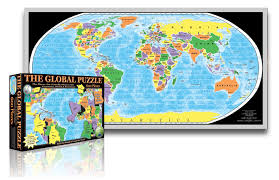
The pieces are shaped like the actual countries. Most days’ itineraries can be covered with one puzzle piece. Some of the largest countries have more than one piece.
Before the start of each school year, I assemble the outer framework of the puzzle — everything except the country pieces — on our school desk and cover it with a sheet of Plexiglass the same size as the desktop. I’ve numbered the backs of the each of the country pieces with their curriculum day and filed the in a 3-ring binder in transparent sheets designed to hold sports trading cards. This makes it easy to find each day’s puzzle piece and add it to the puzzle.
The first year we used this curriculum, the kids put a lot of thought into how they would travel from one place to another (covered wagon, canoe, camel, airplane, helicopter, on foot…) and what they would take with them (sunscreen, mosquito net, winter boots, ice). We discussed climate, altitude, and local wildlife. We also filled out “flight plans,” where we noted the general direction of travel, distance, and time enroute given their chosen method of transportation.
Another year, we researched the local foods and cooked many of them. Many places, we have toured online using YouTube, Google Earth, and Google Images.
Additional resources you may find valuable in your study of geography include the following:
“Geographica” An excellent, easily understood world atlas
“Operation World” – A comprehensive book, organized by country, that contains facts and statistics about every country as well as information about its religious climate and local missions efforts

“Window on the World” – A children’s book based on Operation World and organized by country
“From Akebu to Zapotec” – An alphabet book of unreached people groups
Early on, there were a number of conversations that I really wanted to have but couldn’t — not because the kids weren’t talking yet, because they were, but because they lacked the vocabulary to really understand what we wanted to convey. It’s hard to have a meaningful discussion about diligence or integrity if your kids don’t know the words yet. I realized we were going to have to teach them the words.
This curriculum was born out of that desire coupled with an increasingly urgent need to introduce our very young children to some challenging social concepts (death, hunger, poverty, homelessness, and host of others) as a result of some family travel that was coming up. We needed to address these in a gentle way, when we had time to really discuss them, before the kids saw them firsthand.
I chose picture books as our primary medium for this training. These are engaging, easy to discuss, and able to convey ideas when the vocabulary may not be there yet. We use text and stories from the Bible to back up the ideas, explain their importance and provide further examples, and we use music and video for additional impact and reinforcement.
I developed the first edition of this curriculum the summer that our oldest children were 6 and 4 years old and we implemented it that fall, when they were in first grade and kindergarten. They loved the picture books and the “travel” component of it, as we followed the itinerary for a virtual tour of the world. To this day, we refer to this part of our homeschool day as “Travel,” a word that has come to encompass geography, history, social studies, music, art, science, character studies, Bible, and anything else that we are covering as a family rather than individually.
I didn’t set out to create a curriculum that could be used year after year, but the kids begged to repeat it and so we have, annually. They appreciate the rhythm that it brings to the school year, and I appreciate the review of character ideas. Every year, as they get older and we fold younger siblings into the study, new conversations arise and new discoveries are made. The Bible passages and Family Books are rich enough that I notice something new every time I read them. They never seem to get too old.
This curriculum has been successful in our home. Our kids now have the vocabulary to engage in meaningful conversations about behavior and about things they encounter in everyday life, they understand our values and the marks of good leadership, and they are aware of and sensitive to social issues.
We’re excited to have this in a format that we can share with other families. Hopefully you’ll enjoy it as much as we do.
You can use pretty much any experiment to teach the Scientific Method.
These blank lab worksheet pages have space to write out your question, makes notes on your research, form a hypothesis, design your experiment, record your data and analysis, and write out your conclusion.
 Character core curriculum