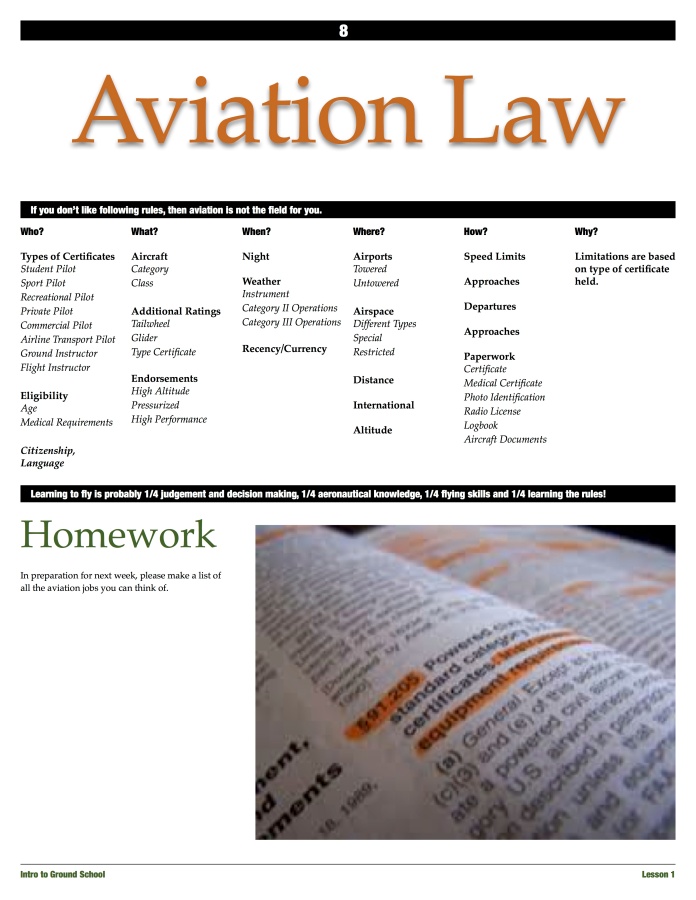
9 Aviation Careers

Print a copy of the following for each student:

Print this list for yourself:  Skills & Interests List

DISCUSSION:

Distribute the Skills & Interests Charts to the students and instruct them, as you read your list, to copy these items down on the appropriate side of their chart.  Afterwards, discuss their charts and find aviation jobs that they would be likely to enjoy.
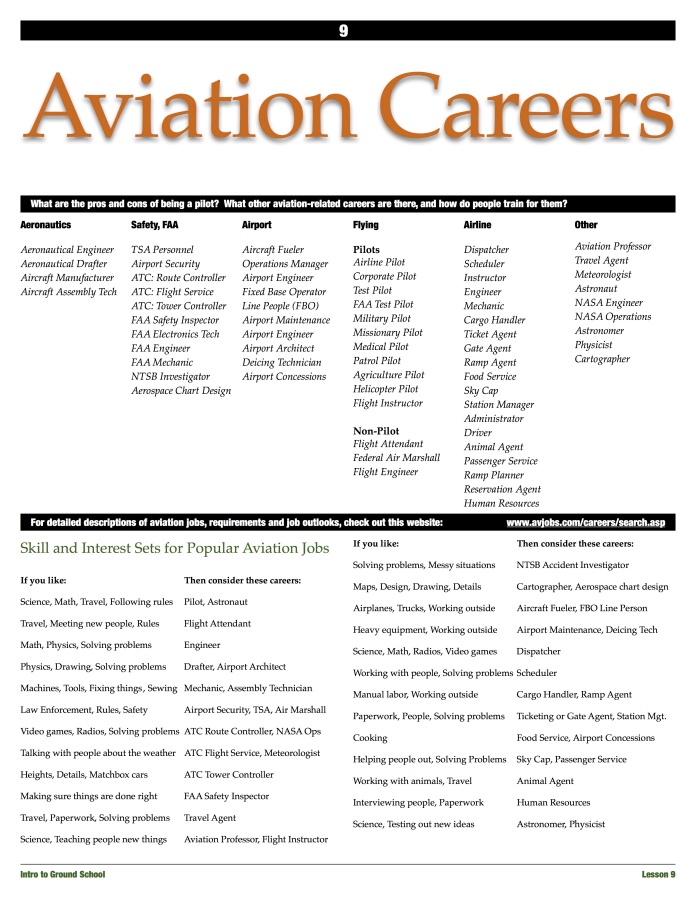
intro-to-ground-school-9-aviation-careers

Standard

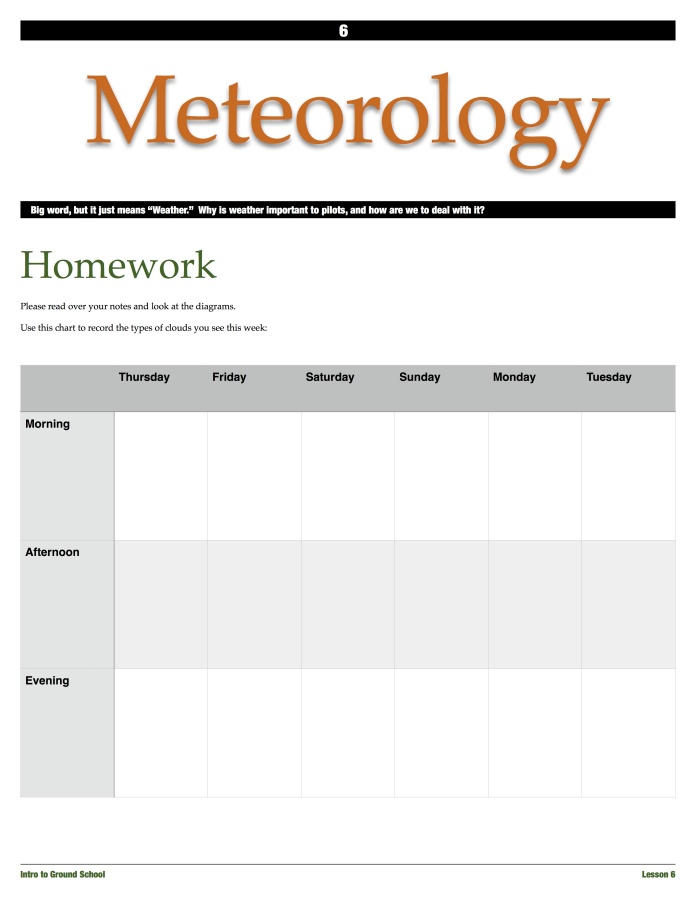
6-7 Meteorology

This is a big topic, so it will take two class periods to cover.

Print a copy of each of the following for each student:

And, if you are teaching a class, print the following for yourself:  Meteorology Notes

DISCUSSION:

Quick intro:  Weather on the ground vs. Weather in the air (flying)…

  • On the ground, what do we care about when it comes to weather?
  • When we’re flying, what do we care about?
    • VFR:
      • Visibility
      • Clouds (remain clear of them!)
      • Icing
      • Wind
      • Runway surface
      • Pressure
    • IFR:
      • Visibility (only for T/O & Landing)
      • Clouds (stormy or lenticular)
      • Icing (at the surface or sustained)
      • Wind (depends on plane)
      • Runway surface
      • Pressure

ATMOSPHERE

*** Diagrams***

  • Atmospheric pressure:  What is it?  (caused by weight of air above you)
  • High Pressure (above 29.92):  Associated with “good weather”
    • Stable air
    • Cool, dense, dry air
    • Increased performance
    • ** Look out for fog, decreased visibility, icing **
  • Low Pressure (below 29.92):  Associated with “bad weather”
    • Unstable air
    • Warm updrafts
    • Decreased performance
    • Humidity

WHAT CREATES WEATHER?

  • MOVING AIR
  • MOISTURE

WHAT MAKES AIR MOVE?

  • Changes in temperature
  • ** Diagram:  Sun, Earth, 45% absorbed, 55% reflected**
  • WHAT AFFECTS AMOUNT OF TEMPERATURE CHANGE?
    • Day/Night
    • Latitude
    • Water/Land
    • City/Rural (dirt, concrete, glass)
    • Season
    • Altitude
  • WIND
    • A change in temperature leads to a change in pressure
    • A never-ending attempt to produce equilibrium = WIND!
      • TRANSPORTS WATER VAPOR
      • SPREADS FOG, CLOUDS, PRECIPITATION

WARM AIR (heated surface):

  • Expands and rises
  • Becomes lighter
  • Becomes less dense

COOL AIR:

  • Compresses and sinks
  • Becomes heavier
  • Becomes more dense

Think of oil and water:

  • Warm air wants to rise to the top because it’s less dense (like oil)
  • Cool air wants to sink to the bottom because it’s more dense (like water)

** Moving air diagrams **

  • Rising air is conducive to cloudiness & precipitation
  • Descending air dissipates clouds

STABLE vs. UNSTABLE air

  • Stratiform:  Strata:  Sheet-like, horizontal
  • Cumuliform:  Cumulus:  Heap

CLOUDS

  • Cirrus
    • Usually indicates weather in a couple of days
  • Cumulus
    • Bumpy flight
    • Might get wet
  • Gray cumulus
    • Precipitation
  • Stratus
    • May be visibility problems
    • May stick around for a while
    • Smooth flight
    • Icing risk!

ICING

  • Rime
  • Clear
  • Mixed

THUNDERSTORMS

  • Cumulus
  • Mature
  • Dissipating

**PAGE 111! **

intro-to-ground-school-6-7-meteorology

Standard

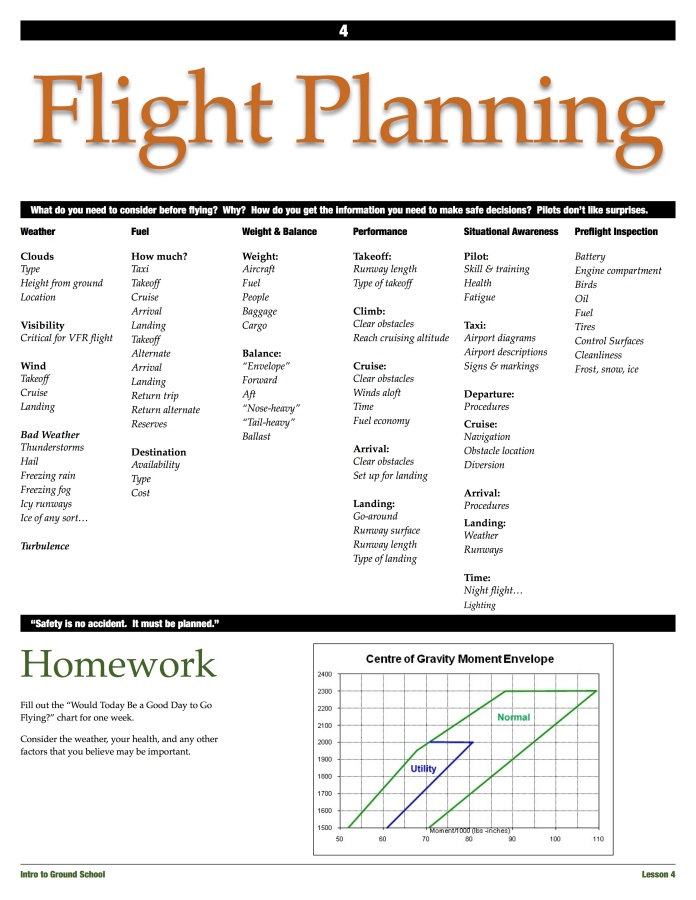
4 Flight Planning

Print out enough copies of the following for each student to have one:

If you are teaching a class, print out a copy of the following for yourself:  Flight Planning

DISCUSSION:

intro-to-ground-school-flight-planning

You can either write the above list, or ask the class for ideas and write those down, then add the things they have missed.

After your list is on the board, write the following list in a separate area:

  • Weather (WX)
  • Fuel
  • Weight & Balance (W/B)
  • Performance (Perf)
  • Situational Awareness (SA)
  • Preflight Inspection (PI)

Return to your original list and, after each item, ask the students which “planning category” covers that surprise.  Write the abbreviation for that category after the surprise.

This exercise shows that most “surprises” can be accounted for in the flight planning process.
intro-to-ground-school-4-flight-planning

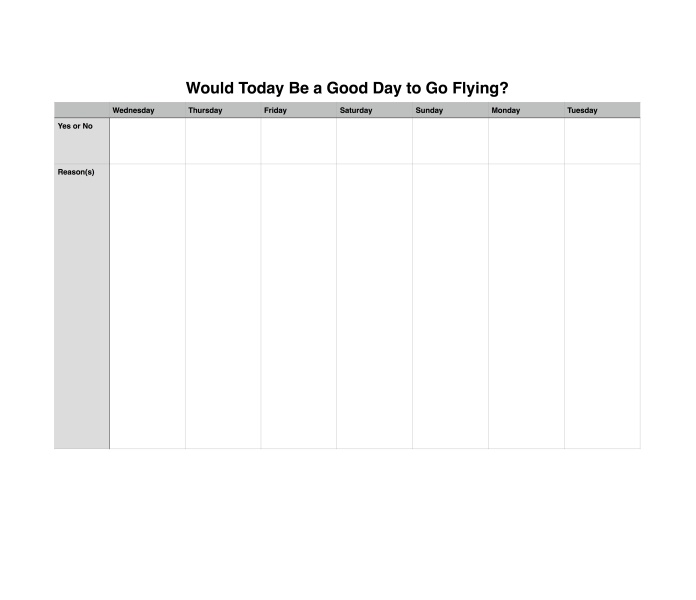
flying-day-chart


Standard

3 Airports

Print a copy for each student:  Intro to Ground School: 3 Airports

DISCUSSION:  (Airports)

Find in Google Earth:  Kijabe Airport

  • Show photos
    • This is, at its most basic, an airport.  What does it have?
      • Runway (dirt)
      • A place to turn around
        • Always take off and land INTO THE WIND.
    • How does this airport break one of the biggest airport rules?  (not straight)
  • Show video (note the windsock):  Caravan Landing at Kijabe

Phases of Flight:

  • Pushback
  • Taxi
  • Run-up
  • Takeoff roll
    • Low-speed regime
    • High-speed regime
  • V1
  • Rotate
  • Climb (departure)
  • Cruise
  • Descent (approach)
  • Landing
    • Touchdown
    • Landing roll
  • Taxi

Cashmere Airport

  • Learning about airports is like learning a special code.
  • What are the numbers on the runway?
  • What are the arrows below the numbers?
    • Zoom into approach end of Runway 25:
      • What are the markings on the taxiway?

Wenatchee Airport

  • Aiming points
  • What are the “X”s for?
  • Find the windsock
  • Point out the PAPI (show picture)
  • Position Markings

Seattle Airport

  • How many runways are there?
  • What are their runway numbers?
  • Find the passenger terminal
  • What’s going on on the north side of the airport?
  • Find the fuel storage

Intro To Ground School 3 Airports.jpg

Additional Resources:

Taxiway Markings, Signs and Lights

Runway Lighting Explained


Standard